Custode

Is your tree getting better, or worse?

Not a one-shot "what's wrong with this leaf" app. A per-tree record that watches the same tree over months, so something changing shows up before it's obvious by eye.

In development — running on one real grove in Western Australia

The wrong question

Every plant-ID app answers what, never whether

Point a phone at a leaf and a dozen free apps will tell you what it is and guess what's wrong with it. That part is solved, and it's free — it will stay free. It also isn't the question anyone who actually cares about a tree is asking.

One-shot diagnosis

  • Answerable from a single photo
  • Every competitor already does this
  • Tells you what it is, today
  • No reason to come back

Custode

  • Needs a registry, an anchor point, and history
  • Nobody else builds the boring part underneath it
  • Tells you whether it's changing
  • Worth more every month you keep it

The record

How it works

01

Register the tree once

A name, a spot on the map, a tag on the trunk. GPS alone isn't accurate enough at typical planting spacing — this is what keeps every later photo pointed at the right tree.

02

Same three shots, every visit — from any source

Canopy, foliage, trunk — from the same anchor point, with a ghost overlay of last time so framing stays consistent. Consistency of capture matters more than sophistication of model. The phone in your pocket is the default, but it isn't the only producer: a drone flyover and Custode's sibling grove-robot, Il Guardino, write into the exact same per-tree record — one registry, whichever of the three actually took the photo that visit.

03

A structured assessment, not a guess

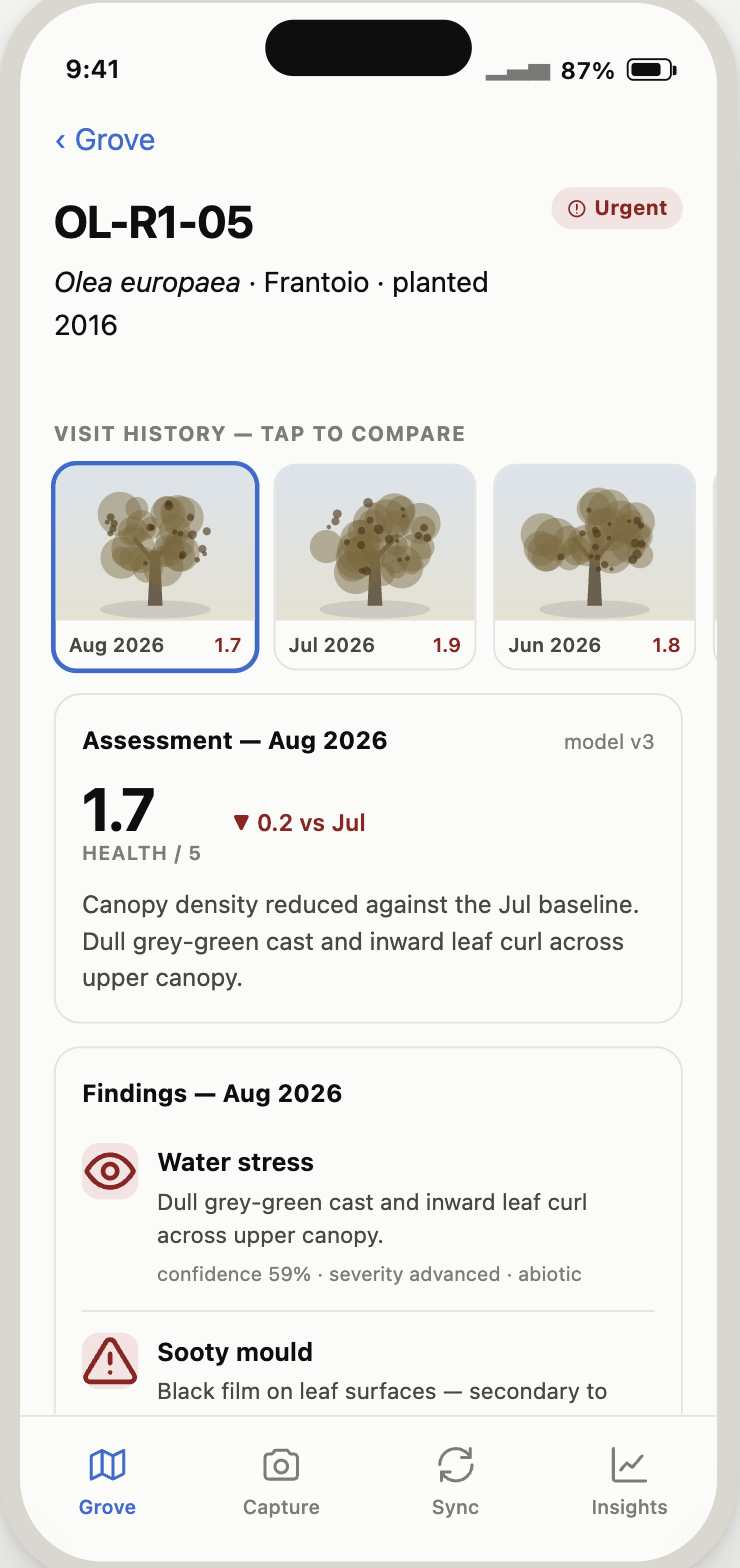
A health score, specific findings with the evidence behind them, and a confidence level — never a bare verdict. A vision-capable Claude model reads all three shots together in one call (so a leaf symptom and what's underneath it get connected, not scored separately), forced through a fixed schema rather than free text — the model can't wander off into prose instead of an answer, and a malformed reply gets retried, not silently parsed-and-guessed.

04

It says when it doesn't know

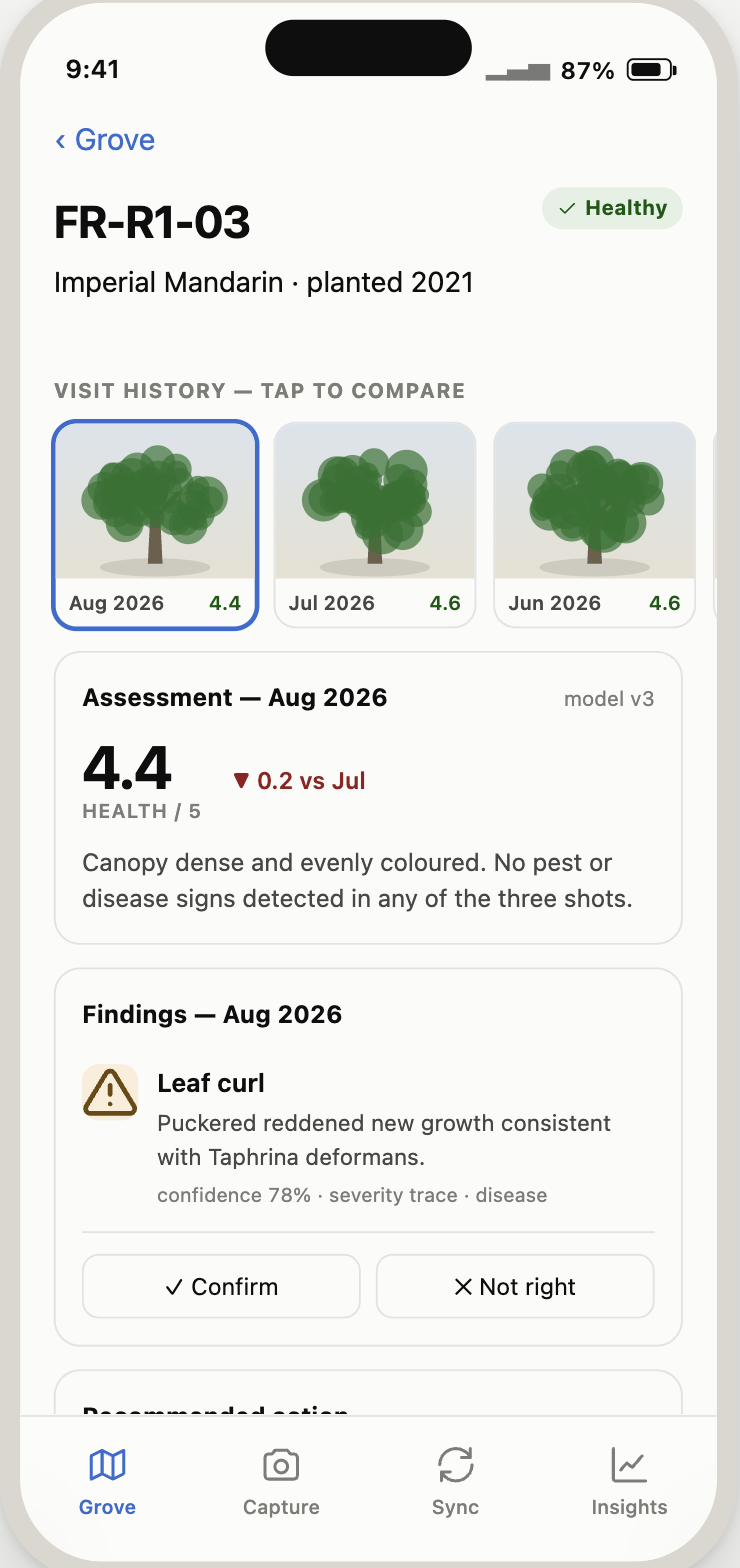
Marginal photos and low-confidence findings get flagged for a human look, not quietly resolved. Triage, not diagnosis — a wrong "it's fine" costs you the tree, and that's the one mistake this is built to avoid.

Why the on-grove test comes first. Before this is anyone else's tool, it has to prove one thing on real trees: does the change detection actually catch something you'd have otherwise missed by eye? That's running now — 80 olive and fruit trees at Piccolo Paradiso, near Collie, Western Australia.

The interface

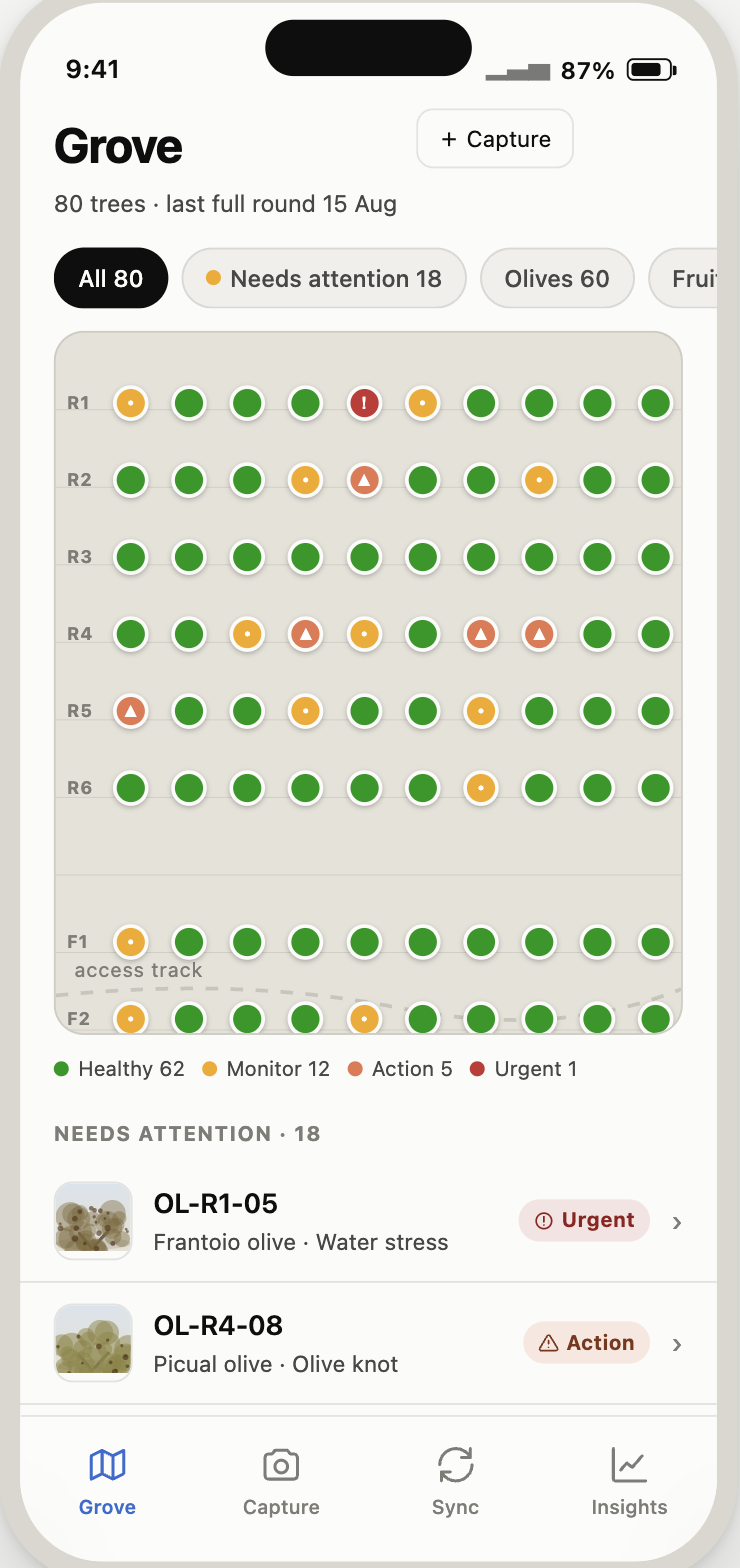
Every tree on the map, colour-coded by the last visit

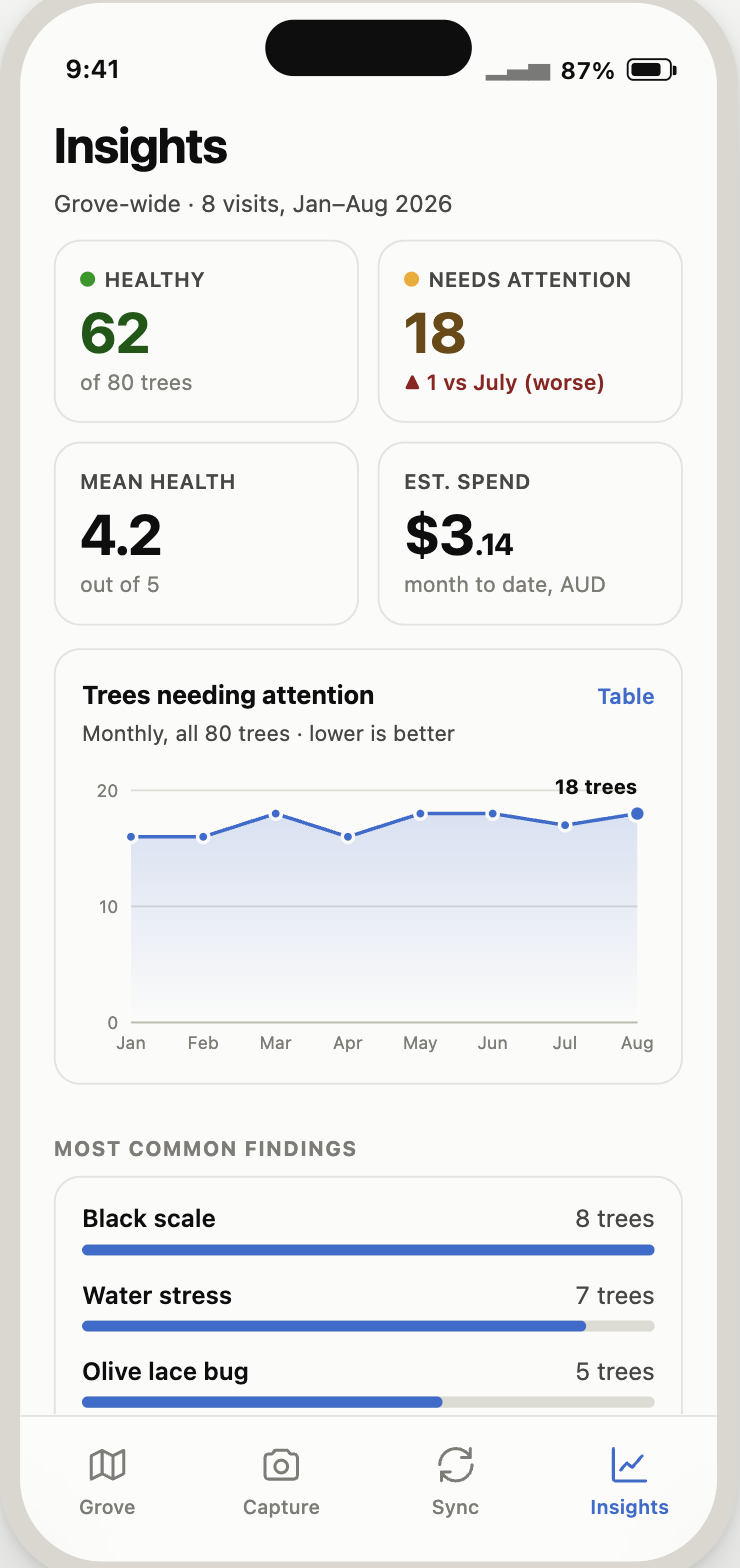
Design mockup for the 80-tree grove. Colour never carries meaning alone — every non-healthy pin also pairs a glyph and a word, so it isn't lost to colour blindness or a glance in bright sun. Swipe through: the map, an olive assessment, a citrus one, and the trend that's the actual point of keeping the record.